
Searching Civil Dockets in Alabama
Alabama's trial portal, Just One Look, is the remote starting point for civil cases. It covers the Circuit and District court system. It splits searches into categories: domestic relations, small claims, state traffic, and child support. Two public entry points exist. One searches by party name; the other by case number. The detailed trial record costs money. The portal itself warns that some cases may not appear. A hit helps you locate an Alabama civil case. But it is not the full clerk file or a certified copy.
Gather a few things before searching. The case number helps if you have it. So do the parties' names, the county, and the court named on a summons or order. Names repeat, so confirm that a result matches the right party role and matter type. Alabama's Circuit Clerk keeps the Circuit and District files. Probate and municipal records live with separate custodians. After the portal, use the Alabama case lookup page for statewide search context. The county directory then routes you to the local clerk.
- Choose the Alabama civil, small-claims, or domestic-relations path that fits the case paper; do not assume all civil matters use one category.
- Search by the known case number or party name. Review the displayed charge before opening paid detail, since a search without a match may still incur a fee.
- Compare the caption, county, court, and party roles with the summons, complaint, or order to avoid a same-name match.
- Read the Case Action Summary for filings, settings, and court actions. Use a later order to confirm the effect of a ruling or judgment.
- For the complete Alabama docket sheet, a filed paper, or a certified copy, contact the right court clerk through the county directory.
Alabama District Civil and Small Claims Limits
Alabama District Court hears civil claims within limits set by statute. Ala. Code § 12-12-30 places the general District civil ceiling at $20,000. The same statute covers unlawful-detainer authority and sets out excluded categories. Small claims run on a separate District Court track, generally capped at $6,000 under § 12-12-31. Anything above the District limit travels a different docket path. The same is true for cases assigned to Circuit Court by law.
The dollar figure alone does not pick the court. Subject matter, the relief requested, venue, statutory exceptions, and appeal rules can each change the route. Alabama Circuit Court holds general civil jurisdiction. Read the court name printed on the filed paper. Ask the clerk when the caption or case type is unclear. The District Court jurisdiction statute is the source for the general limit. Confirm any specific claim against current law.
Note: Alabama small claims has its own procedure and dollar ceiling. It is heard within the District Court system.
Alabama Civil Filing Reports and Case Dockets
The Alabama Administrative Office of Courts publishes civil filing and disposition reports. It also offers interactive Judicial Data products. These reports describe Alabama court activity by reporting period or selected geography. They give useful system-level context. They do not replace an individual Alabama docket. They do not show every filing in a case or confirm a current hearing date. A case search and a caseload report answer different questions.
The AOC's official reports page collects that statewide court data and its reporting tools. When citing totals, use the report's own labels and year. The counts may not equal unique people or open cases.
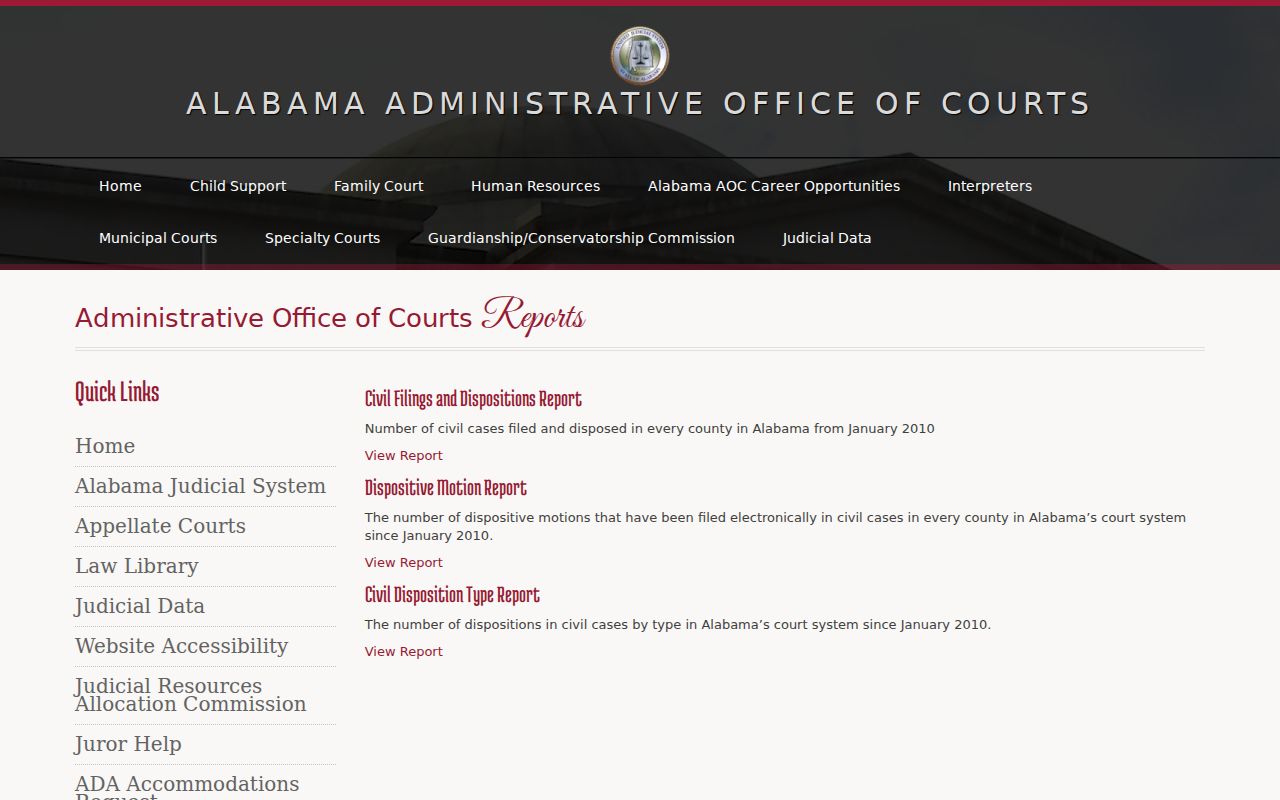
That page is a route to published Alabama court statistics. For a party's own case, search the trial portal and confirm the record with the clerk that keeps it.
What an Alabama Civil Docket Shows
An Alabama civil docket is a dated register of case events, filings, settings, and court actions. The statutory consolidated docket includes parties and the nature of the action. It also lists attorneys, service returns, motion rulings, preliminary matters, and final judgment. Alabama's public portal calls its event history a Case Action Summary. It may show case details and image links. But no confirmed statewide list of public trial-entry codes exists, nor one civil case-number pattern for every court.
| Case number | Use the full number printed on the Alabama court paper. Do not infer a statewide format from another county or court tier. |
|---|---|
| Parties and counsel | May identify plaintiff, defendant, petitioner, respondent, and counsel listed in the Alabama file. |
| Filings and service | Can show a complaint, answer, summons, return of service, motion, order, or another event on the Alabama docket. |
| Settings | May list an Alabama status conference, motion hearing, trial setting, or later reset. Verify a current date with the court. |
| Judgment or disposition | Look for the dated result and read the Alabama order to learn which claims or issues it resolves. |
A Case Action Summary entry is a short label, not the filed document itself. The docket can point toward the complaint, return, or order that matters. When its details or legal effect matter, ask Alabama's Circuit Clerk for that paper.
Note: A docket entry can name a court event. The filed order supplies its scope and effect.
Civil Case Types on Alabama Dockets
Alabama civil matters span Circuit and District dockets. The state portal sorts some case types into categories even when they sit in a division of the same court. General civil claims, small claims, domestic relations, and child support are not interchangeable labels. Probate cases such as estates, wills, and guardianships belong to the county Probate Court. They are not presented as a standard Just One Look civil category.
Domestic relations and juvenile matters can carry privacy limits that differ from an ordinary public contract or property file. A portal category tells you which route is open. It does not guarantee that every caption, entry, or attachment is public. Municipal disputes run through the municipal court's own record channel. Confirm the Alabama court and case type on the summons or petition before seeking a docket copy.
Match Alabama Civil Cases Before Paying
A name search in Alabama often pulls up several cases at once. People share names, so match carefully. Before paying for case detail, line up the case number, county, court, party role, case category, and filing date against a summons, complaint, or any order you already hold. The case number is usually the strongest clue. Alabama trial courts do not follow one confirmed statewide format. Copy its letters and punctuation exactly as the court paper shows them.
Just One Look, Alabama's public entry page, lets you search by name or case number. The deeper query fields sit behind the account or purchase flow. There is no Alabama county selector. Filters for judge, claim type, date, or result are unverified. If the paid search comes back empty, try a different spelling or court tier first. Then call the Circuit Clerk. Remember the portal's own warning that some cases never appear. The charge applies even with no match.
Alabama Civil Settings and Hearings
An Alabama civil docket may show conferences, motion hearings, trial dates, and other settings. A county calendar, though, can cover a whole group of matters, one judge's hearing block, or an entire jury term rather than the current setting for a single Alabama case. Any later order or docket entry can move the date. When a printed calendar conflicts with your notice or an online summary, trust the newest setting. Then contact the clerk or court coordinator.
A scheduling order is not a judgment. A reset is not a dismissal. Preparation differs for a status conference and a motion hearing. A trial block does not mean every listed matter gets called at the posted time. Alabama courts use local calendar labels. There is no statewide public list of civil setting codes. The order itself, plus Alabama court instructions, controls the details.
Note: In Alabama, a newer civil docket entry or court order can change the date printed on an earlier calendar.
Alabama Domestic and Probate Dockets
Alabama's portal lists domestic relations and child support as trial-case categories. A local court may still keep them in a Circuit division. Probate works differently. An estate, will, guardianship, or similar proceeding belongs with the county Probate Court or Judge of Probate. It does not sit on the Circuit Clerk's ordinary civil docket. A city dispute may sit with a municipal clerk instead. The case type, not the word "civil" alone, tells you who holds the record.
Alabama domestic relations can involve private or restricted material. Juvenile records carry their own confidentiality rules. A probate file goes to the county Probate Court. An Alabama Circuit or District case goes to the Circuit Clerk. Ask the right clerk which system holds the matter. That routing keeps searchers from mistaking Alabama's Circuit portal for a complete statewide index of every Alabama civil proceeding.
Why Alabama Civil Dockets Omit Some Discovery
An Alabama civil docket is not a transcript of everything the parties exchanged. Discovery requests, answers, and similar materials usually stay outside the court file. They only become part of the record if someone files them, they back a motion, or a court order requires it. So a missing discovery entry in an online summary proves nothing about what the parties shared.
After judgment, the docket may list a motion, judgment, execution, or garnishment. The signed order or filed request holds the real detail. For any post-judgment question, name the exact document. Ask the Circuit Clerk whether it is on file. Say whether you need an ordinary or certified copy. Alabama's statewide search is an index and access layer, not a substitute for the county-held case papers.
Alabama Civil Docket Access
You can view nonconfidential Alabama Circuit and District docket records at the clerk's office during business hours. Rule 401 governs that access. There is no viewing fee. For remote access, the AOC Electronic Filing information page describes Alacourt.com as a monthly read-only subscription. Just One Look sells case detail on demand. Neither gives you an authenticated copy. Rule 30 governs copies, certification, searches, postage, and file preservation. A local Alabama clerk sets the practical request steps and current charges.
Alabama juvenile, sealed, redacted, and some family records carry access limits. The state's privacy rules separate a public case summary from confidential information and sealed documents. Ala. Code § 36-12-40 recognizes inspection rights for public writings. Its procedural provisions exclude the judicial branch. So Alabama court rules matter too. Rather than reading a blank portal result as a denial, ask the custodian which rule applies to the restricted entry.
Alabama rules that shape access:
Rules of Court-Record Privacy and Confidentiality set statewide terms for public, confidential, sealed, and redacted court records.
Alabama Rules of Judicial Administration, Rule 30 covers copy and search requests, certification, postage, and preservation.
Ala. Code § 36-12-40 states a right to inspect and copy public writings, subject to the court-record rules and the judicial-branch exception.
Give the clerk what makes retrieval quick. That means the case number, court, filing year, and the exact paper you need, plus whether it must be certified. Rule 30 allows search or copy fees and postage. Local forms set the steps and current amounts. Route local forms, terminal access, or an archived-file request to the Alabama county clerk that holds the record.
Note: Alabama docket access and access to a filed document can differ; ask the clerk which rule applies to the specific filing.