
Inside the Alabama Court System
Alabama organizes its judiciary as the Unified Judicial System. The Alabama Circuit Court sits at the top of the trial tier with general jurisdiction. District Courts take limited civil claims. Misdemeanors go there too. Preliminary felony hearings and state traffic matters land there as well. Municipal Courts handle ordinance violations and some local traffic cases. Probate Courts cover estates, wills, guardianships, and similar statutory proceedings.
An appeal builds a new record above the trial case. The Court of Civil Appeals and the Court of Criminal Appeals split assigned categories. The Supreme Court of Alabama stands as the court of last resort with supervisory power over the judiciary. When an appeal begins, the lower-court docket stays with its own clerk. The record holder for any Alabama case varies. The answer turns on case type and court.
| Court | General Role | Record Keeper |
|---|---|---|
| Alabama Circuit Court | General trial jurisdiction, including felonies and larger civil cases | Circuit Clerk |
| Alabama District Court | Limited civil up to $20,000, small claims up to $6,000, misdemeanor, preliminary felony, and traffic matters | Circuit Clerk, by law |
| Alabama Municipal Court | City ordinance and local traffic matters | Municipal court clerk |
| Alabama Probate Court | Estates, wills, guardianships, and other statutory probate matters | Probate Court or Judge of Probate |
| Alabama appellate courts | Appeals assigned to the civil, criminal, or supreme court | Relevant appellate clerk |
Alabama Courts Span 41 Judicial Circuits
Alabama divides its Circuit Courts across 41 judicial circuits. District Courts line up by Alabama county. No single trial court holds every case type, so the statewide Alabama court map takes some reading. One wrinkle: the Circuit Clerk also serves as the District Court clerk under Ala. Code §12-17-160. That dual role does not put municipal or Probate Court files in the Circuit Clerk's hands.
Court counts vary by source for a simple reason. Bessemer operates as an additional District Court location. The fiscal year 2023 (FY2023) annual report from the Alabama Administrative Office of Courts (AOC) presents 67 districts. Judicial allocation materials count 68 operational District Courts. Alabama also has 68 Probate Courts serving 67 counties. These are structure counts, not a change to the county roster.
An unfamiliar Alabama court gives itself away through its citation or case notice. Read that first. Then match the court's tier to the record keeper in the table.
The Alabama Statewide Search Portal
Alabama's public trial lookup is Just One Look, a name AOC material also renders as AlaCourt ACCESS. It sells on-demand searches by name or case number across listed Circuit and District categories: criminal, civil, small claims, state traffic, domestic relations, and child support. A result may carry a Case Action Summary, settings, actions, party details, financial information, and available images. Remember that a portal view is not a certified copy.
Other routes exist alongside it. The Alabama case lookup is one. The AOC Electronic Filing information page describes Alacourt.com as a separate monthly read-only subscriber application. The Alabama appellate Public Portal is yet another system. Just One Look warns that cases may be missing. Its public help pages post no county coverage list, no update schedule, and no backfill date.
| Access Route | What It Provides | Scope or Limit |
|---|---|---|
| Alabama Just One Look | One-case-at-a-time paid name or case-number search; one case detail is included | $9.99 at research time; each additional matched case detail costs $9.99 |
| Alabama case images | Available images may be purchased after opening case detail | $5 for the first 20 pages, then 50 cents per added page at research time |
| Alabama life-of-case monitoring | Optional monitoring for a trial case | $19.99 for District or $29.99 for Circuit at research time |
| Alacourt.com | Monthly subscriber read-only trial case details and images | AOC does not publish its subscription price on the public information page |
| Alabama county docket list | County-context setting-date list; last-name filter is optional | Some cases may not appear; the observed form showed a rolling five-date range |
| Alabama Appellate Public Portal | Public search of appellate case data | Remote appellate documents are restricted to authorized attorney accounts |
Check the live terms before you buy. Prices change, monitoring terms rest with the service, and a no-match search still costs its stated fee. Note: Just One Look covers selected Alabama trial records only, and municipal, Probate, appellate, and federal dockets each run through separate routes.
Alabama Court Workload in FY2023
The Alabama Administrative Office of Courts (AOC) FY2023 report counted 172,306 Alabama Circuit Court filings. Dispositions reached 180,750. District Court added 671,380 filings and 674,175 dispositions. Treat those as processing totals rather than unique people or open cases. Probate, municipal, appellate, federal, and administrative dockets sit outside them entirely.
Traffic led the District Court load. It drew 368,121 filings, the largest listed category. Circuit filings spanned criminal, civil, domestic relations, juvenile, and child-support cases. A statewide search may thus return several categories at once. The full record still turns on court and clerk.
Read counts with their year. Alabama's trial-court figures describe FY2023 filings and dispositions; they do not predict an individual case's timing or guarantee that its docket is online.
For the category breakdowns, turn to the AOC FY2023 Annual Report. The Judicial Data reports add civil filing and disposition dashboards.
How Alabama Dockets Reach the State Index
An Alabama trial filing may arrive through AlaFile or an approved paper route. The Circuit Clerk records it. The court itself controls settings and judicial action. AlacourtPlus supports case processing for Alabama Circuit and District courts. Just One Look and Alacourt.com offer separate read-only views. Access serves the public or subscribers where available.
State law shapes the Circuit record. Ala. Code §12-17-94 describes a consolidated civil and criminal docket sheet and assigns the Circuit Clerk's duties over the official entries, including filings, orders, and case actions.
Alabama docket flow: County filing → County court record → Clerk and judge processing in AlacourtPlus → Statewide public display where available → County clerk verification.
These Alabama record stages are not interchangeable. The portal publishes no uniform refresh interval and warns that cases may be missing. Paper, restricted, older, municipal, and Probate Court records may follow other routes entirely. Treat a missing result as a reason to call the Alabama clerk. It is not proof that no case exists.
The Alabama Administrative Office of Courts
Alabama's Administrative Office of Courts backs the Chief Justice and the Unified Judicial System. Its services include administration, data, case-management technology, training, forms, calendars, municipal-court support, and statistics. Think of the AOC as the statewide service office. It does not hold an individual trial file.
AOC resources link to court rules, Judicial Data, e-filing help, and public access. AlacourtPlus processes Alabama Circuit and District cases for clerks and judges. Just One Look serves public searches. A shared system never moves a county record out of the local court's authority.
Alabama Administrative Office of Courts
Statewide court administration, e-filing and case-technology information, public resources, and court data.
Note: The Alabama Administrative Office of Courts runs statewide systems, but each case record still lives with the local clerk who filed it.
E-Filing Through AlaFile
Alabama's e-filing front end is AlaFile. Attorneys licensed in the state file there, and eligible self-represented users can register too. Filing is only half the picture. Filers use AlaFile. Clerks and judges work in AlacourtPlus. The public searches through Just One Look or a county clerk.
Mandatory e-filing began October 1, 2012, though court rules carve out exceptions. Rule 44 sets the channels, clerk review, exceptions, and what happens after a technical failure. One caution matters here. Submission is not acceptance. Nothing goes on public display instantly, and the tools promise no refresh time.
The AOC's AlaFile and e-filing information covers accounts, exceptions, and technical help. Questions split cleanly. A filing problem goes to the filing system or clerk. A docket-search question goes to the public access route.
Alabama's Specialty Court Programs
Specialty and accountability courts in Alabama run through participating local courts. They have no portal of their own. The AOC lists adult, family, and juvenile drug courts. Mental-health courts, veterans treatment courts, and Court Referral Officer services are listed too. The case itself stays in Circuit, District, or juvenile court. Treatment and juvenile details may carry extra privacy limits.
The AOC's FY2023 annual report counted 14 Family Drug Courts. It also counted 7 Juvenile Drug Courts, 27 Veterans Treatment Courts, and 14 Mental Health Courts. Those figures cover one report year. They don't guarantee every program is active in every county now.
The Alabama specialty-court and accountability-court resource from the Administrative Office of Courts links to program pages and maps.
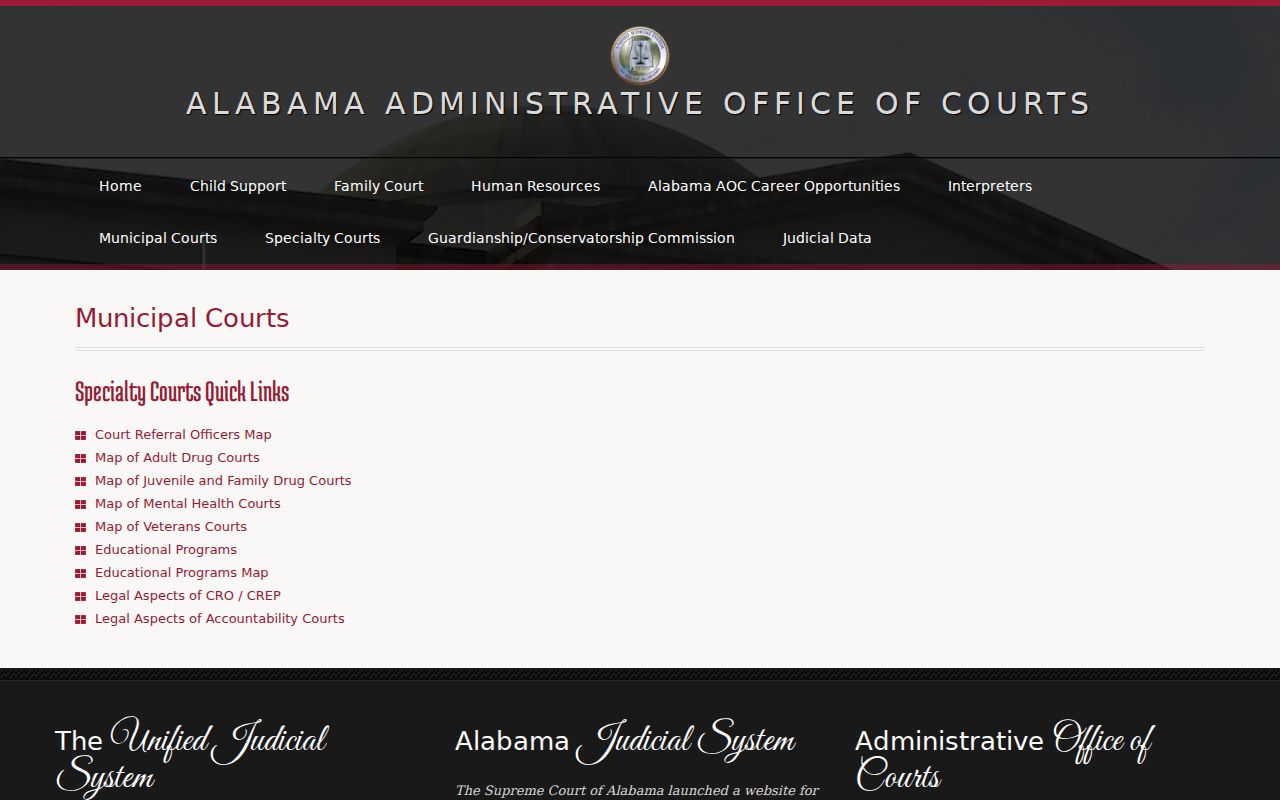
The AOC's statewide specialty-court resource catalogs these Alabama programs. Participation still depends on the local court and its rules, which also govern what the case record shows.
Alabama Portal vs County Docket
The Alabama trial portal can find a Circuit or District case and display its Case Action Summary, settings, actions, and any available images. It is not the official record. The portal warns that cases may be missing. It also publishes no backfill date or update schedule.
The Circuit Clerk holds Circuit files and serves as District Court clerk. Probate and municipal records sit with separate custodians. So when an entry is missing, a certified copy is needed, or a different court tier is involved, skip the portal and contact the clerk who holds that record.
| Alabama Feature | Alabama Statewide Portal | Alabama County Docket |
|---|---|---|
| Search role | Remote trial-court lookup for listed categories | Local Circuit and District case records, plus route to the correct separate court |
| Case detail | Case Action Summary and available information or images | Official case entry and local confirmation |
| Coverage | Some cases may not appear; no complete coverage matrix is published | Clerk can check the local file and explain restricted or archived records |
| Copies | Paid portal views or images are not certified originals | Request certified copies from the clerk who holds the record |
Start with the Alabama County Directory to pick the right county page. That route handles Circuit and District questions well. A city citation may still need the municipal clerk. A probate case belongs with Probate Court.
Note: An Alabama public result can omit a protected document even when the case itself stays visible to the extent the court rules allow.
Alabama's Recent Court Access Rules
Alabama's Rules of Court-Record Privacy and Confidentiality took effect January 1, 2025. They cover access, restricted records, sealing, and redaction. Within one Alabama file, a search result, a docket entry, and a document can each carry different access limits.
A revised Rule 44 took effect September 1, 2025, updating e-filing procedure. Neither set of rules puts every court file online or guarantees a complete statewide index. Read the Alabama privacy and confidentiality rules and Rule 44 for the details.
Alabama Court Technology and History
Alabama court technology grew in stages: record imaging first, then e-filing, then a separate appellate system. Each milestone changed administration. It doesn't mark the moment every historical case became searchable.
- By 1998, Alabama AOC reporting documented court-record imaging in use.
- Alabama civil e-filing was authorized in 2005 as a staged project.
- Alabama orders in 2011 and 2012 extended electronic filing to criminal case types; general statewide requirements took effect October 1, 2012, with exceptions and accommodations.
- An Alabama municipal case-management initiative began in 2022, while appellate records moved to the C-Track Public Portal for newer material.
- Alabama court-record privacy rules took effect in 2025, followed by revised e-filing Rule 44 later that year.
Digitization never reached every Alabama record. Older paper files may still require a request to the local clerk.
Alabama Appeals Use a Separate Court Portal
An appeal gets its own Alabama appellate number and docket. The Appellate Public Portal lets the public search by number. Title, category, filed date, and court work as filters too. Closed cases are excluded by default until the filter changes.
Remote access to appellate documents and filing is limited to authorized attorneys. Anyone else can inspect nonconfidential papers at the appellate clerk's office. Records filed before March 21, 2022 sit on ACIS. Newer filings live in the Alabama Appellate Public Portal. Its official user guide walks through a case on appeal.
Note: An appellate result never replaces the lower-court file. Trial and appeal carry separate clerks, numbers, and record histories.